
The field you reach for first
There is a moment most reservoir engineers know well, the moment of reservoir analogue selection. You are building a development concept, the data is thin, the timeline is tight, and someone in the room says: what about the field next door? Or the one a colleague worked on five years ago, or the one everyone in the basin has been citing for the last decade, a familiar reference that feels solid precisely because it is shared.
The brain reaches for the familiar, the nearby, the recently discussed. In reservoir engineering, that instinct has a name: local analogue bias.
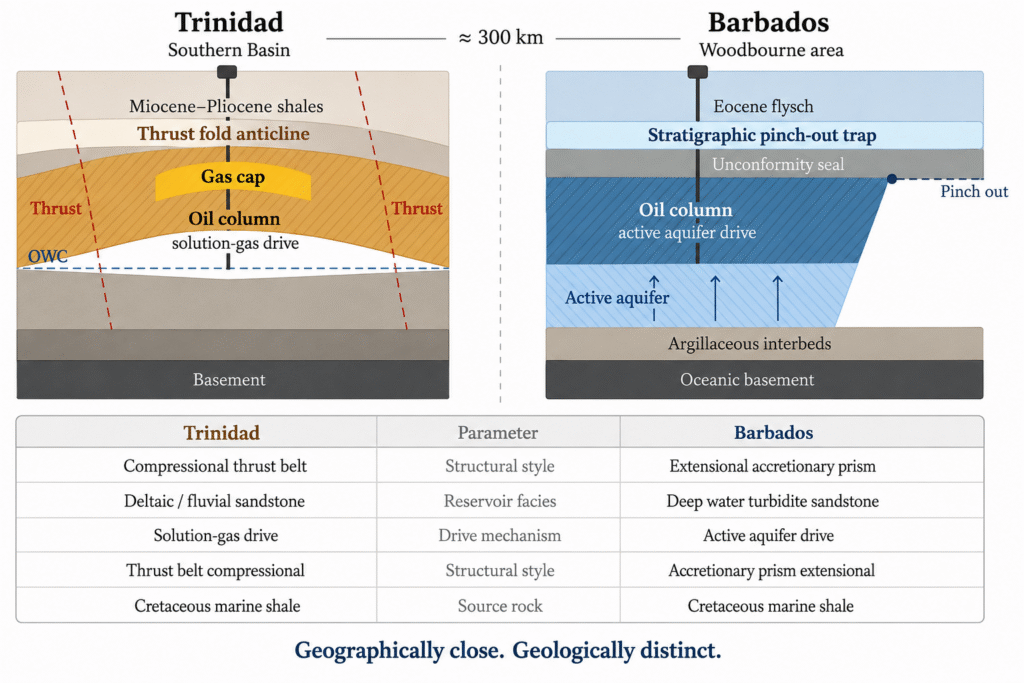
But geographic proximity alone tells you very little about what lies underneath. A field fifty kilometres away can have a fundamentally different depositional environment, drive mechanism, fluid type or development history to yours. A field on a different continent, one nobody in the room has worked on, might be the closest geological match in the world.
GeoExpro made this point well in a piece on analogue methodology: teams up and down the West African and South American coasts have used the Jubilee field as a reference for exploration opportunities, even when their own prospects share almost none of Jubilee’s reservoir characteristics, structural setting or development conditions. The field became a reference point not because it was the best analogue, but because it was the most familiar.
Why Reservoir Analogue Selection Needs a Global Lens
Belltree was engaged to assess production and reserves potential for undrilled prospects in Uganda and Kenya’s East African Rift System, across the Lake Albert and South Lokichar areas. The team ran a global reservoir analogue selection study using bMark™, benchmarking against 253 developments worldwide, including 42 in Africa.
A local analogue approach would have suggested something very different. The study revealed a recovery factor gap of roughly 15 percentage points against current development practices, and uncovered significant upside through improved waterflooding and EOR strategies — strategies that comparable fields elsewhere had already proven out.
That insight did not come from the nearest field. It came from asking what 253 comparable developments spread across the globe had learned the hard way about well density, offtake rates and waterflood management in reservoirs with similar characteristics. The difference between a local reference frame and a global one was not academic. It was 15 recovery factor percentage points.
Reservoir Analogue Selection Under Peer Review
Now consider the same challenge from a different perspective. You are reviewing a development plan where every analogue comes from the same region, the same operator, the same decade — and the recovery factor assumptions sit at the optimistic end. The peer review team is looking for context. But the reference frame is too narrow to provide it.
This is where independent benchmarking changes the conversation. It doesn’t replace the engineer’s judgement, it gives that judgement context that no single team’s experience can replicate. Show that a recovery factor assumption sits in the 75th percentile of 400 comparable developments globally, or that three fields with identical drive mechanisms underperformed at the same development density, and the discussion moves from opinion to evidence.
The strongest development plans don’t just ask what the field next door tells us. They ask what the best-performing analogue in the world can teach us, and what those operators did differently.
bMark™ gives reservoir engineers and geoscientists access to 51,000+ global field analogues for benchmarking, development planning, reserves validation and CCS screening.
How much value is hiding in the analogues you’re not looking at?
Request a demo to explore how bMark™ can strengthen development planning, reserves validation, recovery factor forecasting, and CCS screening.