
CCUS and Net Zero: Why Hard-to-Abate Sectors Need Carbon Capture
BENCH OBJECTIVES. BELLTREE
Why Net Zero Won’t Happen Without CCUS.
A conversation with Nihal Darraj, CCS Researcher, Imperial College London
As the Carbon Capture Global Summit prepares to bring together more than 800 industry leaders in London this September, Belltree’s Bench Objectives podcast sat down with Nihal Darraj, CCS researcher at Imperial College London, CO₂ Storage Lead at the Global CCS Institute, and recipient of the IPTC Young Professional Achievement Award 2025. The conversation, hosted by Grant Stewart, covers the state of CCUS, the critical role of data and simulation in scaling the technology, and the challenges that still stand in the way.
At Belltree, we believe the energy transition requires both the right data and the right conversations. Bench Objectives is our podcast series bringing together leading voices in upstream energy and decarbonisation.
What is CCUS?
CCUS (Carbon Capture, Utilisation and Storage) is a set of technologies that capture CO₂ emissions from industrial processes or power generation, then either store it permanently underground or repurpose it for industrial use. It is considered essential for decarbonising “hard-to-abate” sectors, like cement and steel, where emissions can’t be eliminated by switching energy sources alone.
Why CCUS Is Essential for Net Zero
Belltree: How does CCUS contribute to the broader net zero goal, and what is the potential for the technology in regions like the Middle East and Africa?
ND: There are a lot of decarbonisation technologies out there, and I want to start by saying they all contribute to the greater goal. But we have a long history of experience as an industry in the subsurface. CCUS is a proven technology. We know how it works. We know how to deal with the subsurface, how to store CO₂, how to handle it.
A recent IEA report suggested that CCS could account for more than 25% of the progress towards net zero. I would go further and say net zero won’t happen without CCUS, especially for the hard-to-abate sectors like cement.
The problem with cement is that even if you eliminate fossil fuels from the process entirely, you still have process emissions. There is nothing you can do about that except capture and store the CO₂. CCS is not optional in that context. It is the only answer.
CCUS in the Middle East, Africa and Climate-Vulnerable Nations
Regionally, you see significant investment in North America, driven largely by the US 45Q tax credit, which has been a major commercial enabler. But there is substantial momentum in the EU through the European Green Deal, and in the Middle East. Saudi Aramco is active, and countries like Egypt are progressing on both CCUS and hydrogen.
The message is broadly understood. My concern is that the most climate-vulnerable countries, Pakistan and Bangladesh among them, are developing nations that do not have the capital to fund these projects. That is where the issue of climate justice becomes very real.
The Data Interoperability Problem in CCS
GS: Data plays a crucial role in CCUS. How do you see data analytics impacting project performance?
ND: There is an inherent problem in the oilfield, which is data in incompatible formats. A common platform where data can be accessed and worked with consistently would be a major advancement for the CCS world.
But beyond interoperability, what matters most is the accumulation of lessons learned. We know the subsurface is not one-size-fits-all. Every project is different. But there are transferable principles, and capturing those lessons systematically, building on that institutional knowledge, is how you actually scale CCS. Without that infrastructure, every project starts from scratch.
Why Simulation Is the Backbone of CCS Project Design
GS: What role does software and simulation play specifically in CCS project development?
ND: This is essentially the core of my research. In the lab, we work with core samples, pieces of rock perhaps six centimetres long. The reservoir that sample comes from is kilometres across. The entire challenge of CCS development is extrapolating from that small piece of rock to the behaviour of an entire formation.
You need reservoir simulators and upscaling algorithms to do that. Without them, you cannot say with any confidence how CO₂ will migrate, how it will be trapped, or whether a given location is safe for storage. Software is not a supporting tool in CCS. It is the pillar.
If you run an experiment and report your findings, the first question you will get is: how does this translate to a business decision at reservoir scale? You need simulation to answer that. It enables organisations to see the bigger picture, connecting what you observe at core scale to what happens across a kilometre-scale formation, and ultimately whether a project is viable.
Public Acceptance: The Biggest Barrier to CCUS Deployment
GS: What are the most significant challenges you see for CCUS going forward?
ND: One of the biggest is public acceptance. You can have a technically and commercially viable CCS project, and it can fail because of community opposition. People read a single article and feel qualified to reject a technology they do not fully understand, and political parties respond to that because they want to be re-elected. This is not a criticism. It is the reality of how decisions get made.
The challenge for the scientific and engineering community is communication. We know our material. What we often lack is the ability to translate complex technical realities into language that builds public trust. That gap is one of the greatest obstacles CCUS faces right now, and there is no quick fix. It requires sustained, honest engagement.
Pace vs. 2050: Is CCUS Moving Fast Enough?
The other major challenge is pace. We are in 2026. Net zero by 2050 is 24 years away. That sounds like a long time, but in terms of deploying infrastructure at the scale required, it is not. All hands need to be on deck.
Advice for Early-Career CCUS Professionals
GS: What advice would you offer to professionals early in their careers in this field?
ND: Keep an open mind, always, and never stop learning. You can learn something from anyone, at any stage of their career. Listen to everybody, be respectful, and always seek perspective. That is how you grow, and in a field that is moving as quickly as this one, that mindset is not optional. It is essential.
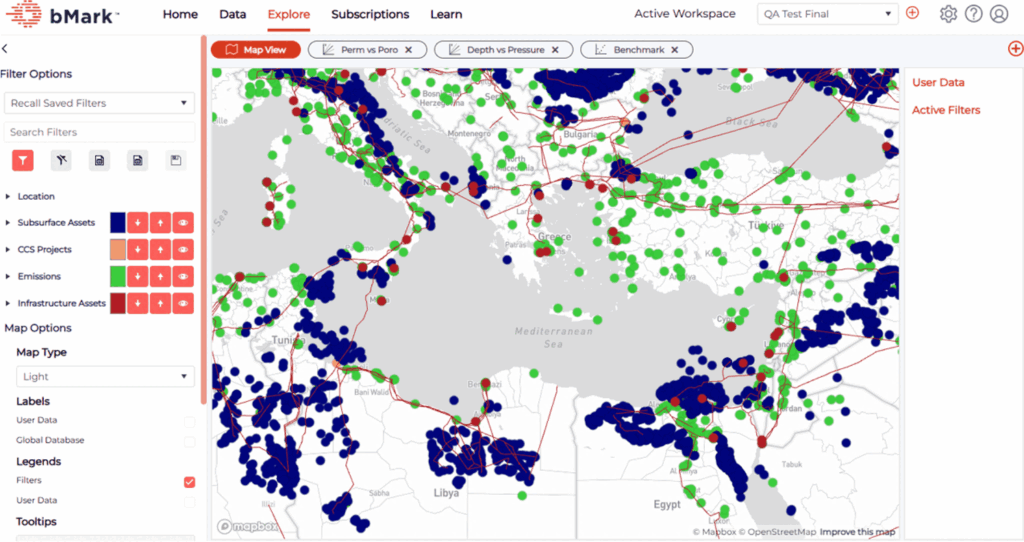
Bench Objectives is a podcast series produced by Belltree exploring the intersection of data, technology and the energy transition. Belltree’s bMark™ CCS platform allows carbon capture and storage projects to be designed, benchmarked, risk-assessed and booked in a single workflow, drawing on a global database of 51,000+ oil and gas fields, 500+ saline aquifers and 400+ CCS projects. To learn more or request a demonstration, visit belltreegroup.co.uk.
